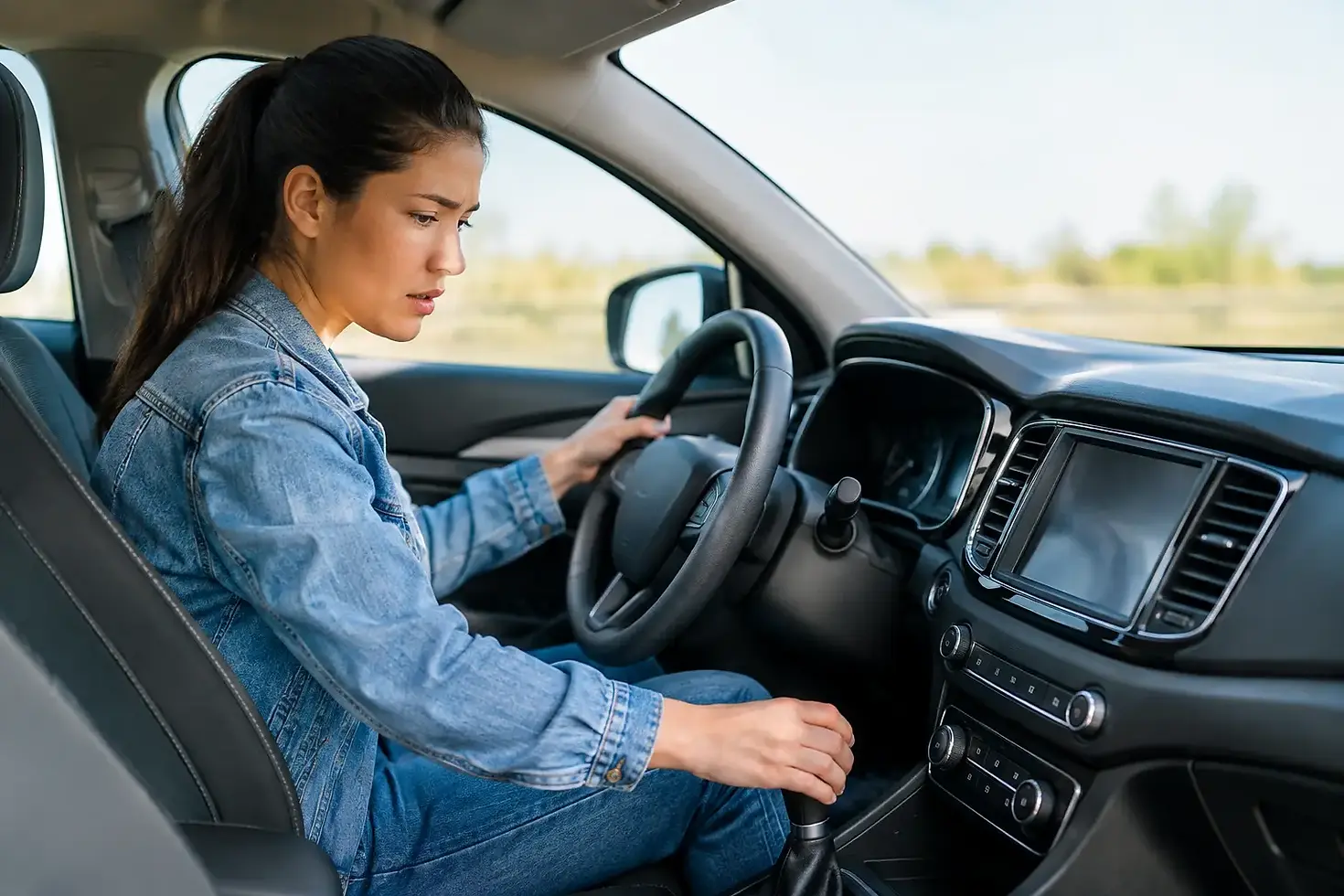
Why Cars Stall and How Learners Can Prevent It

A stall can feel huge when you are waiting at a busy Rochdale roundabout or pulling away on a hill in Oldham. The good news is that why cars stall is usually straightforward: the engine has not received enough power to keep turning as the clutch connects it to the wheels. It happens to every manual learner, and plenty of experienced drivers too. A stall is not a sign that you cannot drive. It is useful feedback that helps you fine-tune your timing.
Why cars stall in a manual car
A running engine needs enough revs to continue spinning. When you select first gear and lift the clutch, the engine begins transferring power through the gearbox to move the car. If the clutch comes up too quickly, or there are not enough revs from the accelerator, the load on the engine is greater than it can handle. The engine stops.
Think of the clutch as a bridge between the engine and the wheels. Pressing the pedal fully down separates them. Lifting it gradually reconnects them. The biting point is the small working zone where the car wants to move but the clutch is still controlling that connection. Finding and holding this point for a moment gives the engine time to cope.
Stalling is most common when moving off in first gear, but it can also happen if you slow down in too high a gear. For example, approaching a junction in third gear at very low speed can leave the engine struggling. Selecting a lower gear, or pressing the clutch down when appropriate, prevents that sudden loss of power.
The most common reasons learners stall
Releasing the clutch too fast
This is the main cause. New drivers are understandably focused on checking mirrors, signals, pedestrians, cyclists, other traffic and the road ahead. With so much happening, the left foot can lift quickly without noticing. The car may lurch forwards and then cut out.
The answer is not to hold the clutch at the biting point for a long time. That can cause unnecessary clutch wear. Instead, pause briefly at the biting point, allow the car to gain a little momentum, then continue releasing the clutch smoothly as you add gentle acceleration.
Not using enough accelerator
Some cars need very little gas to move away on level ground, while others need a little more. This depends on the vehicle, the engine, the road surface and whether the car is carrying passengers. Your instructor will help you understand the particular car you are learning in.
As a general guide, a light, steady press on the accelerator before and during the clutch release helps keep the engine alive. Avoid stamping on it. High revs can make the car surge and make clutch control harder. Smooth control beats force every time.
Moving off uphill
Hills add resistance, so the engine needs more power than it does on a flat road. This is why a pull-away that works perfectly in a quiet car park may result in a stall on a slope. You may also roll backwards if you release the footbrake before the car has enough drive.
A controlled hill start uses the handbrake to keep the car secure while you find the biting point and add suitable gas. When you feel the vehicle is ready to move, release the handbrake and continue with calm clutch control. Practising this method makes steep streets and busy junctions far less intimidating.
Selecting the wrong gear
Trying to move away in third gear creates a heavy load on the engine and will often cause a stall. Equally, remaining in a high gear while slowing for traffic can make the car judder before it cuts out.
Build a simple habit: first gear for moving off, then change up as speed increases. When slowing, use the appropriate gear for your speed and situation. You do not need to rush through gear changes. Accurate, well-timed changes are safer than hurried ones.
Rushing because other drivers are waiting
Pressure from traffic is one of the biggest reasons a learner stalls. Perhaps the lights have changed, a car is behind you, or you are concerned that someone will beep. That feeling can lead to fast feet and skipped steps.
Other road users may be impatient, but your priority is a safe, controlled move-off. Take the extra second to prepare properly. A short pause is always better than pulling out without enough control or observation.
How to prevent a stall before it happens
The best way to reduce stalls is to practise the same moving-off routine until it feels natural. Set up the car correctly, select first gear, prepare the gas and clutch, observe properly, then move away with control. A consistent routine frees up mental space for the road around you.
Spend time in a quiet area practising clutch control. Feel for the biting point and notice the small changes in the car: the engine note may deepen, the front of the car may lift slightly, and the vehicle may want to creep forwards. These clues are more useful than staring at the pedals.
Do not be discouraged if the correct amount of accelerator feels different in another car. Manual cars vary. A diesel may pull away with minimal gas, while a small petrol engine can need more revs, particularly on a hill. Good drivers adapt to the vehicle rather than expecting every car to behave exactly the same way.
Your seating position also matters. If you are stretching for the clutch or sitting too close to the pedals, smooth movement is harder. Make sure you can press the clutch fully to the floor without locking your knee, and that your heel position lets you lift the pedal in a controlled way.
What to do safely if your car stalls
A stall during a driving lesson or practical test is not automatically a serious fault. What matters is how you respond. If you stay calm, secure the car and move away safely when ready, you can show good judgement.
Follow this simple recovery process:
Keep the footbrake pressed and press the clutch fully down.
Select neutral and restart the engine if it has stopped.
Select first gear, prepare the clutch and accelerator, then check all around again.
Move away only when it is safe, using the same calm routine as before.
The observation check is essential. Traffic conditions can change while you are restarting, especially at traffic lights, roundabouts and busy town-centre junctions. Never focus so heavily on restarting that you forget the road environment.
If you stall at a junction and the lights change, do not panic. Secure the car, restart it and wait for the next safe opportunity if necessary. Trying to rush across because you feel embarrassed can turn a small mistake into a risky one.
Does stalling matter on the driving test?
Examiners understand that drivers can stall, particularly in an unfamiliar test car or under pressure. One stall does not mean an automatic fail. A minor stall that is dealt with safely and promptly may have little effect on the result.
It becomes more serious if the stall creates danger or affects other road users. For instance, rolling back towards a vehicle on a hill, stalling in the path of approaching traffic, or repeatedly losing control at a busy junction can lead to faults. This is why lessons should focus on recovery as well as prevention.
Practising local road types can make a real difference. The stop-start traffic, hills, roundabouts and tighter residential roads around Rochdale, Oldham, Middleton and Harrow each create different challenges. With structured practice and a patient instructor, you learn to read the road while managing the pedals without rushing.
Can automatic cars stall?
A conventional automatic car does not usually stall when moving off because there is no manual clutch for the driver to operate. That is one reason some learners choose automatic lessons, especially if clutch control causes significant anxiety.
However, automatic driving still requires careful speed control, observation and planning. It removes one task, not the need for safe decisions. The right choice depends on your confidence, your budget, the type of licence you want and the vehicles you expect to drive after passing. Remember that an automatic-only licence does not allow you to drive a manual car without taking another test.
A stall is simply part of learning the relationship between your feet, the engine and the road. Treat each one as a chance to slow down, reset and improve. With regular practice, the biting point becomes familiar, your pull-aways become smoother, and the busy road ahead starts to feel like exactly where you belong.


Comments